
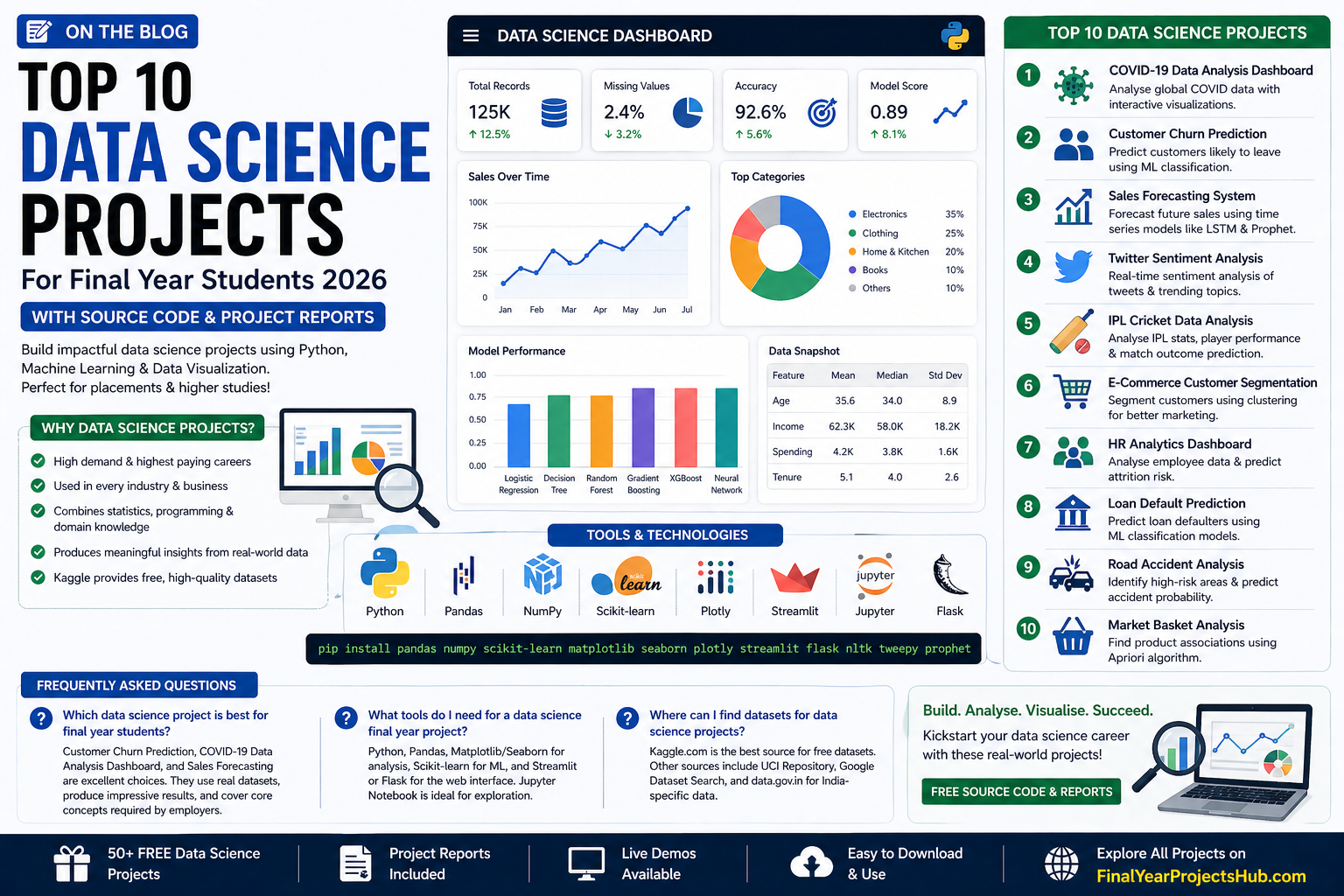
Top 10 Data Science Projects for Final Year Students with Source Code 2026
Data Science is one of the fastest-growing and highest-paying fields in technology. Companies across every industry — finance, healthcare, retail, government — are hiring data scientists to help them make better decisions using data.
A Data Science final year project demonstrates your ability to collect, clean, analyse, and draw insights from real-world data — a skill that is in massive demand in 2026. Here are the Top 10 Data Science projects perfect for final year students.
Why Data Science Projects Are Valuable in 2026
- Data scientists earn some of the highest salaries in the tech industry
- Every company regardless of size or sector needs data professionals
- Data science combines statistics, programming, and business thinking
- Projects produce visual, easy-to-understand outputs that impress evaluators
- Kaggle provides free, clean datasets for virtually every domain imaginable
Top 10 Data Science Final Year Projects
1. COVID-19 Data Analysis Dashboard
Technologies: Python, Pandas, Plotly, Streamlit
Analyses global COVID-19 data including case counts, death rates, vaccination progress, and recovery rates. Displays interactive charts and country comparisons on a Streamlit dashboard.
2. Customer Churn Prediction
Technologies: Python, Scikit-learn, Pandas, Flask
Predicts which telecom or banking customers are likely to cancel their subscription using classification algorithms. Helps businesses take proactive retention actions.
3. Sales Forecasting System
Technologies: Python, LSTM, Prophet, Pandas, Plotly
Forecasts future sales for a retail business using historical sales data and time series models including Facebook Prophet and LSTM neural networks.
4. Twitter Sentiment Analysis Dashboard
Technologies: Python, Tweepy, NLTK, Streamlit, Pandas
Collects tweets on any topic in real time and analyses their sentiment to determine public opinion. Displays live sentiment scores, trends, and word clouds.
5. IPL Cricket Data Analysis
Technologies: Python, Pandas, Matplotlib, Seaborn, Streamlit
Analyses IPL cricket match data to find patterns in team performance, player statistics, venue analysis, and match outcome prediction. Extremely popular with Indian students.
6. E-Commerce Customer Segmentation
Technologies: Python, K-Means Clustering, Pandas, Plotly
Segments e-commerce customers into groups based on purchasing behaviour using K-Means clustering. Helps businesses personalise marketing campaigns for each segment.
7. HR Analytics Dashboard
Technologies: Python, Pandas, Plotly, Streamlit, Scikit-learn
Analyses employee data to identify patterns in attrition, performance, salary, and promotions. Builds a predictive model to identify employees at risk of leaving.
8. Loan Default Prediction System
Technologies: Python, Scikit-learn, Pandas, Flask, Gradient Boosting
Predicts whether a loan applicant will default based on financial history and personal data. Uses Gradient Boosting and Random Forest classifiers with high accuracy.
9. Road Accident Analysis and Prediction
Technologies: Python, Pandas, Folium, Scikit-learn, Streamlit
Analyses road accident data to identify high-risk locations, times, and causes. Uses machine learning to predict accident probability for given conditions.
10. Retail Market Basket Analysis
Technologies: Python, Apriori Algorithm, Pandas, Mlxtend, Flask
Discovers product associations in supermarket transaction data using the Apriori algorithm. Generates association rules like “customers who buy X also buy Y.”
Frequently Asked Questions
1. Which data science project is best for final year students?
Customer Churn Prediction, COVID-19 Data Analysis Dashboard, and Sales Forecasting are excellent choices. They use real datasets, produce impressive visual outputs, and cover core data science concepts that employers test in interviews.
2. What tools do I need for a data science final year project?
Python, Pandas, Matplotlib/Seaborn for analysis, Scikit-learn for machine learning, and Streamlit or Flask for the web interface. Jupyter Notebook is recommended for exploration and analysis.
3. Where can I find datasets for data science projects?
Kaggle.com is the best source for free, clean datasets covering every domain. Other good sources include UCI Machine Learning Repository, Google Dataset Search, and data.gov.in for India-specific data.
Leave a Reply