
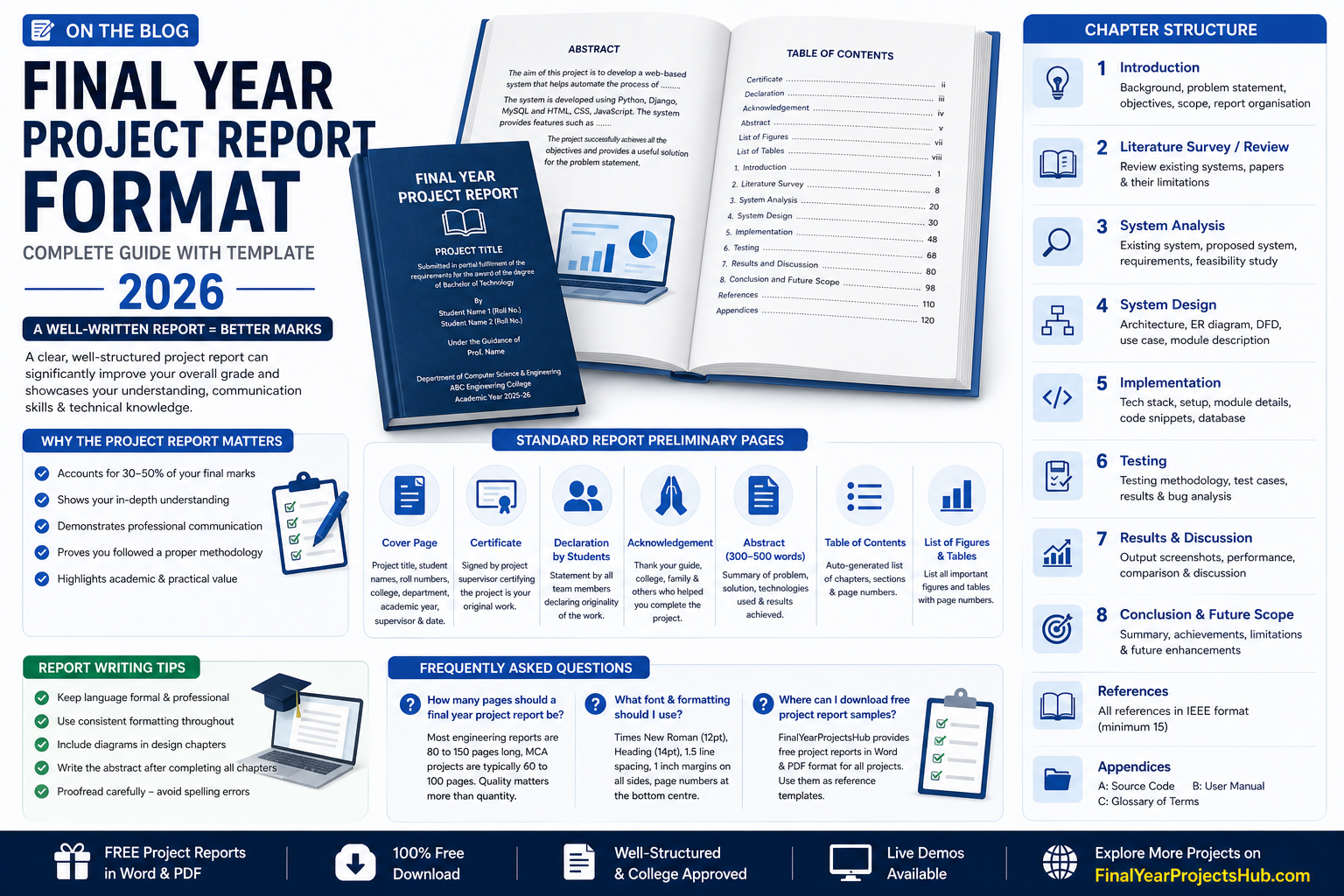
Final Year Project Report Format – Complete Guide with Template 2026
Writing a final year project report is often more challenging than building the actual project. A well-structured, professionally written report can significantly improve your overall project grade — even if your project is not the most technically complex.
This complete guide covers the correct final year project report format, chapter structure, writing tips, and common mistakes to avoid.
Why the Project Report Matters
Most colleges allocate 30 to 50 percent of your final year project marks to the report and presentation. A clear, well-organised report demonstrates:
- That you understand your project deeply
- That you can communicate technical ideas professionally
- That you followed a proper software development methodology
- That your project has academic and practical value
Standard Final Year Project Report Format
Cover Page
Includes: Project title, student names, roll numbers, college name, department, academic year, supervisor name, and submission date. Use the standard format provided by your college.
Certificate Page
A signed declaration from your project supervisor certifying that the project is your original work submitted for the partial fulfilment of your degree requirements.
Declaration by Students
A statement by all team members declaring that the project work is original and has not been submitted elsewhere for any other degree or examination.
Acknowledgement
A brief paragraph thanking your project guide, college, family, and anyone who helped you complete the project. Keep it genuine and professional — 1 page maximum.
Abstract
A concise summary of your entire project covering: the problem you solved, the solution you built, the technologies used, and the results achieved. This is often the first thing evaluators read — make it strong.
Table of Contents
Auto-generated from your headings. Include chapter numbers, section headings, and page numbers.
List of Figures and List of Tables
If your report has more than 5 figures or tables, include dedicated lists after the table of contents.
1. Introduction
- Project Background and Motivation
- Problem Statement
- Objectives of the Project
- Scope of the Project
- Organisation of the Report
2. Literature Survey / Review
Review at least 8 to 10 existing systems, papers, or solutions related to your project. For each, explain: what it does, what it does well, and what its limitations are. Then explain how your project addresses those limitations.
3. System Analysis
- Existing System and Its Limitations
- Proposed System
- Functional Requirements
- Non-Functional Requirements
- Feasibility Study (Technical, Economic, Operational)
4. System Design
- System Architecture
- Database Design (ER Diagram, Schema)
- Data Flow Diagrams (DFD Level 0 and Level 1)
- Use Case Diagrams
- Module Description
5. Implementation
- Technology Stack Used
- Development Environment Setup
- Module-wise Implementation Details
- Code Snippets (key functions only — don’t paste all code)
- Database Implementation
6. Testing
- Testing Methodology
- Unit Testing
- Integration Testing
- System Testing
- Test Cases with Expected and Actual Results
7. Results and Discussion
- Output Screenshots
- Performance Results (accuracy, speed, error rates)
- Comparison with Existing Systems
- Discussion of Results
8. Conclusion and Future Scope
- Summary of Work Done
- Achievements and Contributions
- Limitations of Current System
- Future Enhancements
References
List all references in IEEE format. Include textbooks, research papers, websites, and documentation you consulted. Minimum 15 references expected.
Appendices
- Appendix A: Full Source Code
- Appendix B: User Manual
- Appendix C: Glossary of Terms
Project Report Writing Tips
Keep language formal and professional — avoid casual words and first-person sentences like “I built this.” Use “The system was developed” instead.
Use consistent formatting — same font (Times New Roman 12pt is standard), same heading sizes, same margin (1 inch all sides) throughout.
Include diagrams in every design chapter — evaluators love visual representations of system architecture and database design.
Write the abstract last — it is easier to summarise your project after all other chapters are complete.
Proofread carefully — spelling and grammar errors make a poor impression and can cost you marks.
Frequently Asked Questions
1. How many pages should a final year project report be?
Most engineering final year project reports are 80 to 150 pages long. MCA projects are typically 60 to 100 pages. Quality matters more than quantity — a 80-page focused, well-written report is better than a 200-page padded one.
2. What font and formatting should I use for the project report?
Standard formatting: Times New Roman font, size 12 for body text, size 14 for headings, 1.5 line spacing, 1 inch margins on all sides, and page numbers at the bottom centre.
3. Where can I download free project report samples?
FinalYearProjectsHub provides free project reports in Word and PDF format for all listed projects. These can be used as reference templates to understand proper formatting and content structure.



Leave a Reply