
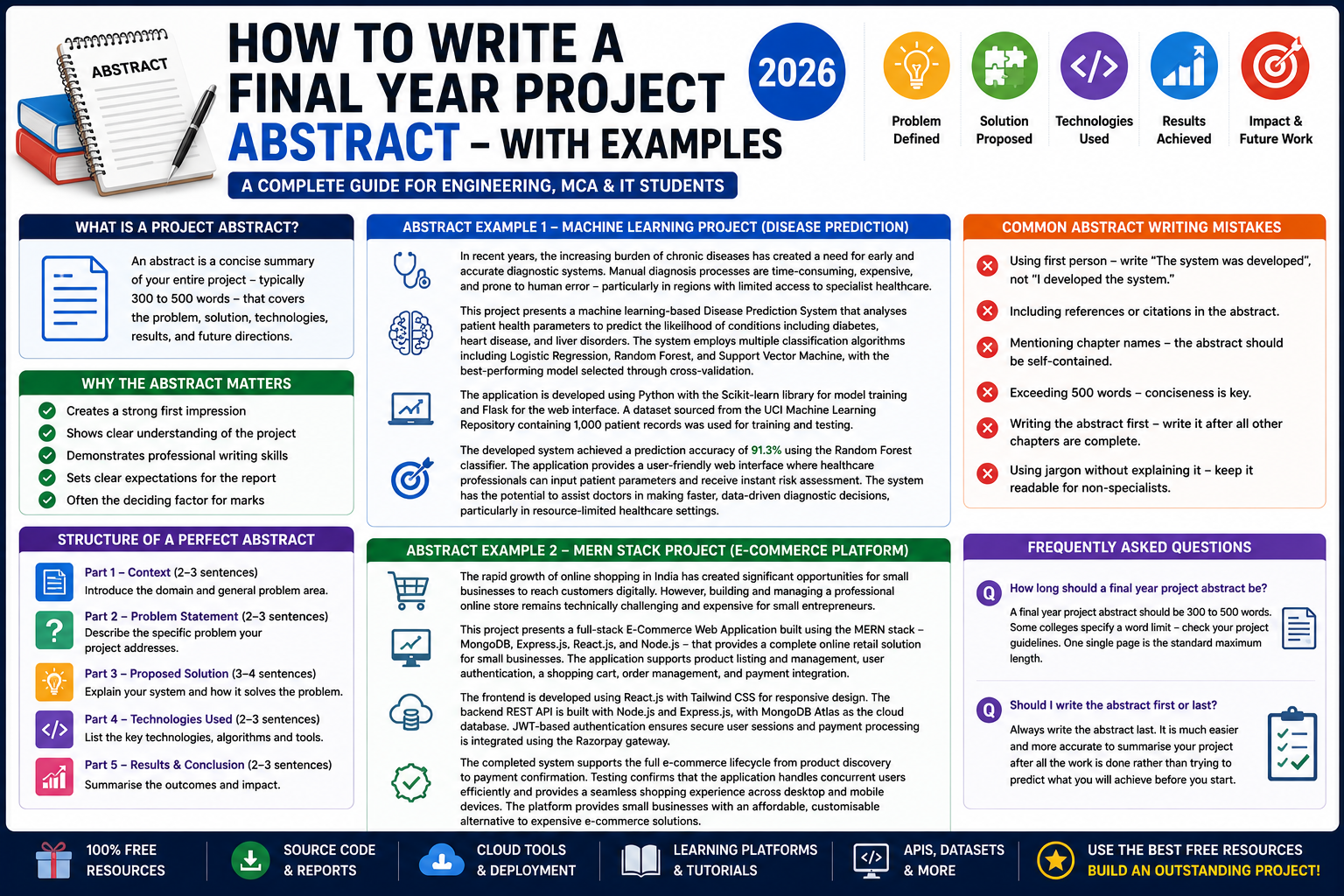
How to Write a Final Year Project Abstract – With Examples 2026
The abstract is the first and most important section evaluators read in your final year project report. A strong, well-written abstract immediately creates a positive impression and sets the tone for your entire report.
Yet most students write the abstract last — and rush through it. This guide will teach you exactly how to write a compelling, professional project abstract with real examples.
What is a Project Abstract?
An abstract is a concise summary of your entire project — typically 300 to 500 words — that covers:
- The problem your project solves
- Your proposed solution and approach
- The technologies and tools used
- The key results and outcomes achieved
- The scope and future directions
Think of it as a movie trailer for your project — it should make the reader want to know more.
Why the Abstract Matters
Many evaluators read only the abstract before your viva presentation. A poor abstract creates a bad first impression that is hard to overcome, even with a technically excellent project. A great abstract:
- Shows you clearly understand what you built and why
- Demonstrates professional writing and communication skills
- Sets clear expectations that your project then fulfils
- Is often the deciding factor for marks in borderline cases
Structure of a Perfect Project Abstract
Your abstract should follow this 5-part structure:
- Part 1 — Context (2-3 sentences): Introduce the domain and the general problem area.
- Part 2 — Problem Statement (2-3 sentences): Describe the specific problem your project addresses.
- Part 3 — Proposed Solution (3-4 sentences): Explain your system and how it solves the problem.
- Part 4 — Technologies Used (2-3 sentences): List the key technologies, algorithms, and tools.
- Part 5 — Results and Conclusion (2-3 sentences): Summarise the outcomes and impact.
Abstract Example 1 — Machine Learning Project
- In recent years, the increasing burden of chronic diseases has created a need for early and accurate diagnostic systems. Manual diagnosis processes are time-consuming, expensive, and prone to human error — particularly in regions with limited access to specialist healthcare.
- This project presents a machine learning-based Disease Prediction System that analyses patient health parameters to predict the likelihood of conditions including diabetes, heart disease, and liver disorders. The system employs multiple classification algorithms including Logistic Regression, Random Forest, and Support Vector Machine, with the best-performing model selected through cross-validation.
- The application is developed using Python with the Scikit-learn library for model training and Flask for the web interface. A dataset sourced from the UCI Machine Learning Repository containing 1,000 patient records was used for training and testing.
- The developed system achieved a prediction accuracy of 91.3% using the Random Forest classifier. The application provides a user-friendly web interface where healthcare professionals can input patient parameters and receive instant risk assessment. The system has the potential to assist doctors in making faster, data-driven diagnostic decisions, particularly in resource-limited healthcare settings.
Abstract Example 2 — MERN Stack Project
- The rapid growth of online shopping in India has created significant opportunities for small businesses to reach customers digitally. However, building and managing a professional online store remains technically challenging and expensive for small entrepreneurs.
- This project presents a full-stack E-Commerce Web Application built using the MERN stack — MongoDB, Express.js, React.js, and Node.js — that provides a complete online retail solution for small businesses. The application supports product listing and management, user authentication, a shopping cart, order management, and payment integration.
- The frontend is developed using React.js with Tailwind CSS for responsive design. The backend REST API is built with Node.js and Express.js, with MongoDB Atlas as the cloud database. JWT-based authentication ensures secure user sessions and payment processing is integrated using the Razorpay gateway.
- The completed system supports the full e-commerce lifecycle from product discovery to payment confirmation. Testing confirms that the application handles concurrent users efficiently and provides a seamless shopping experience across desktop and mobile devices. The platform provides small businesses with an affordable, customisable alternative to expensive e-commerce solutions.
Common Abstract Writing Mistakes to Avoid
- Do not use the first person — write “The system was developed” not “I developed the system.”
- Do not include references or citations in the abstract.
- Do not mention chapter names — the abstract should be self-contained.
- Do not exceed 500 words — conciseness is a key quality of a good abstract.
- Do not write the abstract first — write it after all other chapters are complete.
- Do not use jargon without briefly explaining it — the abstract should be readable by non-specialists.
Frequently Asked Questions
1. How long should a final year project abstract be?
A final year project abstract should be 300 to 500 words. Some colleges specify a word limit — check your project guidelines. One single page is the standard maximum length.
2. Should I write the abstract first or last?
Always write the abstract last. It is much easier and more accurate to summarise your project after all the work is done rather than trying to predict what you will achieve before you start.
Leave a Reply