
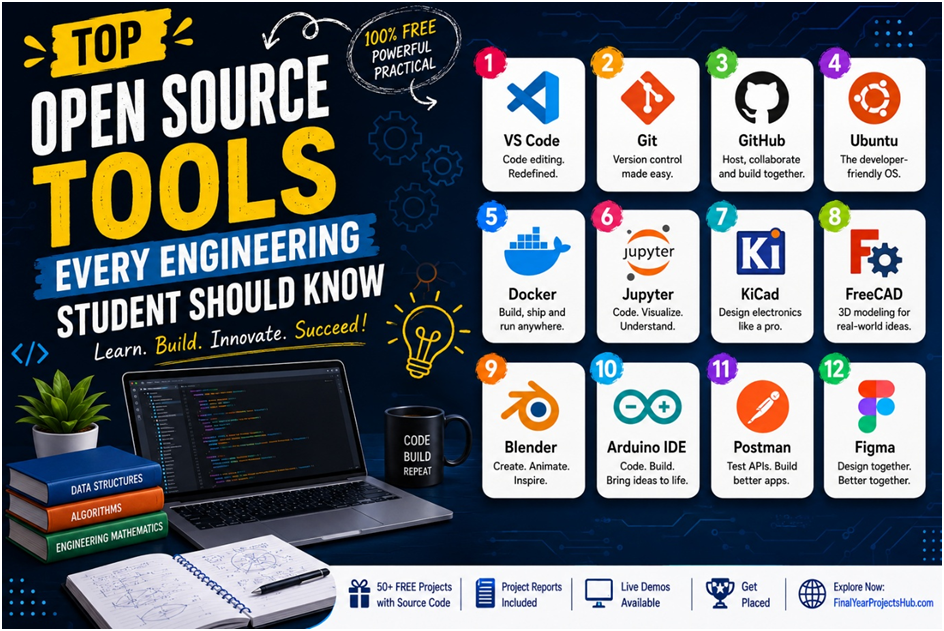
Top Open Source Tools Every Engineering Student Should Know (2026 Guide)
Engineering students today have access to powerful open-source tools that can improve coding, design, collaboration, learning, and project development — all for free. Whether you are a computer science student, electronics engineer, mechanical engineer, or beginner programmer, learning these tools can give you a huge career advantage.
In this blog, you’ll discover the best open-source tools every engineering student should know in 2026.
Why Open Source Tools Matter
Open-source software allows students to:
- Learn real-world technologies
- Build projects without expensive software
- Collaborate with developers worldwide
- Improve technical skills
- Prepare for internships and jobs
Many top tech companies also use open-source technologies in daily development.
1. Visual Studio Code
Best for: Coding and development
Visual Studio Code is one of the most popular code editors for students and developers. It supports multiple programming languages like Python, Java, C++, JavaScript, and more.
Features
- Lightweight and fast
- Extensions for every language
- Integrated terminal
- Git support
- AI coding extensions
Why Students Should Learn It
Most modern developers use VS Code in professional environments, making it a valuable skill for engineering students.
2. Git
Best for: Version control
Git helps students track code changes and collaborate on projects.
Features
- Save project history
- Team collaboration
- Branching and merging
- Professional workflow management
Career Benefit
Git is one of the most demanded skills in software engineering interviews.
3. GitHub
Best for: Hosting and sharing projects
GitHub allows students to upload projects, contribute to open source, and build portfolios.
Why It’s Important
- Showcase projects to recruiters
- Participate in hackathons
- Collaborate globally
- Learn from open-source repositories
4. Linux Ubuntu
Best for: Operating systems and programming
Ubuntu is beginner-friendly and widely used in servers, cybersecurity, cloud computing, and development.
Skills You Learn
- Command line usage
- File management
- Shell scripting
- Server basics
Bonus
Many engineering colleges and companies prefer Linux knowledge.
5. Docker
Best for: Application deployment
Docker helps students run applications in isolated environments called containers.
Why Learn Docker?
- Simplifies project setup
- Useful in DevOps and cloud computing
- Industry-standard technology
6. Jupyter Notebook
Best for: Python, AI, and data science
Jupyter Notebook is perfect for machine learning, data analysis, and academic research.
Popular Among
- AI students
- Data scientists
- Researchers
- Python learners
7. KiCad
Best for: Electronics engineering
KiCad is an open-source PCB design tool used by electronics students.
Features
- Circuit design
- PCB layout
- 3D visualization
- Simulation support
8. FreeCAD
Best for: Mechanical and civil engineering
FreeCAD helps students create 3D models and engineering designs.
Useful For
- Mechanical design
- Product modeling
- CAD learning
- Prototyping
9. Blender
Best for: 3D design and animation
Blender is widely used for animation, rendering, game design, and simulations.
Engineering Uses
- Product visualization
- 3D animations
- Game development
- Architecture modeling
10. Arduino IDE
Best for: Robotics and IoT
Arduino IDE helps students program Arduino boards for electronics and robotics projects.
Perfect For
- IoT projects
- Smart home systems
- Robotics
- Sensor-based applications
11. Postman
Best for: API testing
Postman is used to test APIs and backend systems.
Why Students Use It
- Backend development
- API learning
- Software testing
- Web development projects
12. Figma
Best for: UI/UX design
Figma helps students design websites, apps, and prototypes.
Skills You Learn
- Interface design
- Wireframing
- Team collaboration
- Product design basics
Final Thoughts
Learning open-source tools can help engineering students become industry-ready faster. Start with tools related to your field, build projects consistently, and upload your work to GitHub.
Even mastering 3–4 tools deeply can improve your:
- Resume
- Internship opportunities
- Freelancing skills
- Placement preparation
- Real-world engineering knowledge
The earlier you start, the stronger your technical foundation becomes.


Leave a Reply