
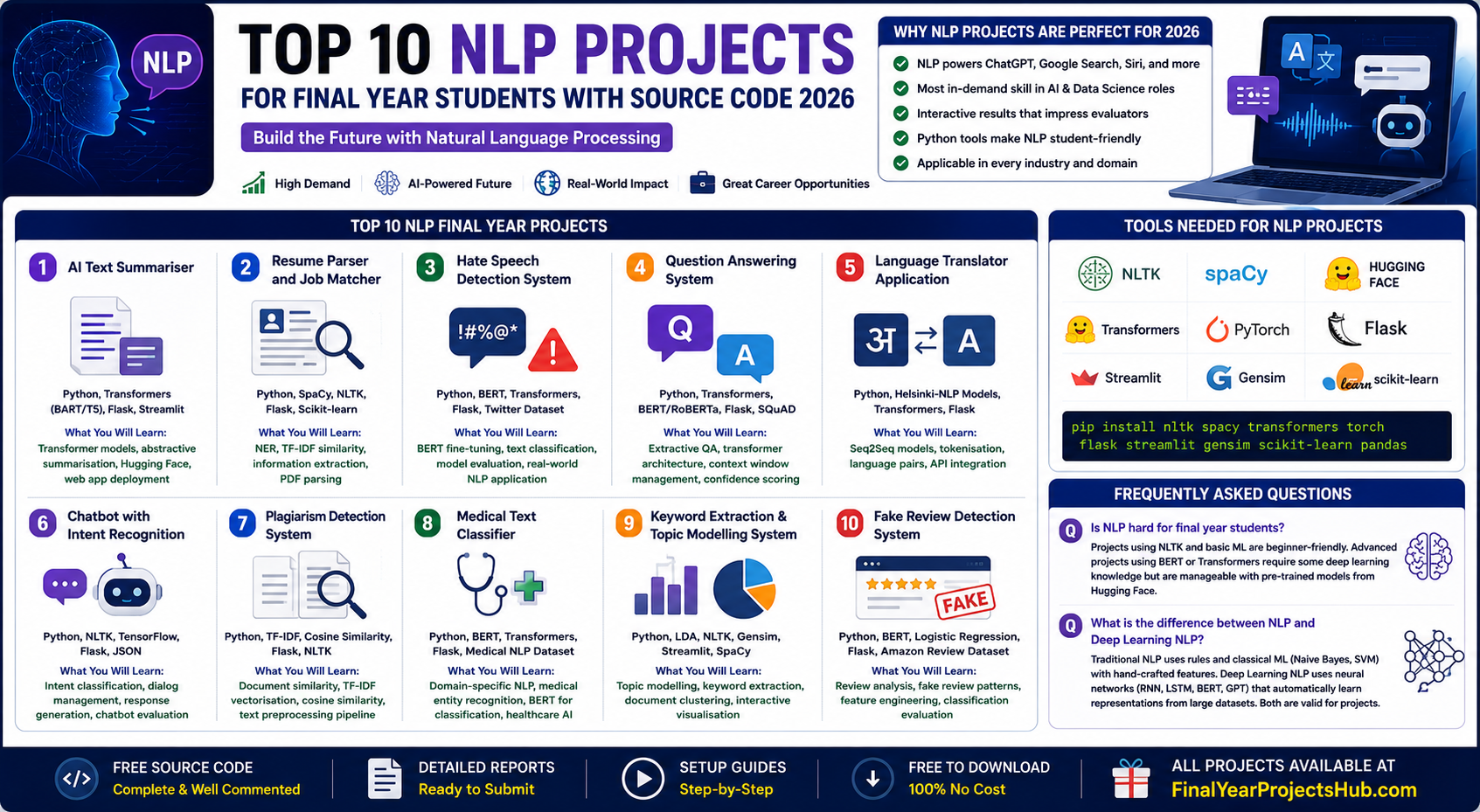
Top 10 NLP Projects for Final Year Students with Source Code 2026
Natural Language Processing (NLP) is the branch of AI that gives computers the ability to understand, interpret, and generate human language. It powers technologies you use every day — Google Search, Gmail Smart Reply, ChatGPT, Siri, Alexa, and language translation tools.
NLP final year projects are among the most impressive and forward-looking projects you can build in 2026. Here are the Top 10 NLP projects with free source code available on FinalYearProjectsHub.
Why NLP Projects Are Perfect for 2026
- NLP is the foundation of ChatGPT, Bard, and all large language models
- NLP skills are among the most in-demand in AI and data science roles
- NLP projects produce visible, interactive outputs that impress evaluators
- Python’s NLTK, SpaCy, and Transformers make NLP accessible to students
- Every industry needs NLP — healthcare, legal, finance, customer service
Top 10 NLP Final Year Projects
1. AI Text Summariser
Technologies: Python, Transformers (BART/T5), Flask, Streamlit
Automatically generates concise summaries of long documents, articles, or research papers. Uses state-of-the-art transformer models for abstractive summarisation.
What You Will Learn: Transformer models, abstractive vs extractive summarisation, Hugging Face library, web app deployment
2. Resume Parser and Job Matcher
Technologies: Python, SpaCy, NLTK, Flask, Scikit-learn
Extracts key information from resumes — skills, experience, education — and matches candidates to suitable job descriptions using NLP similarity scoring.
What You Will Learn: Named Entity Recognition (NER), TF-IDF similarity, information extraction, PDF parsing
3. Hate Speech Detection System
Technologies: Python, BERT, Transformers, Flask, Twitter Dataset
Automatically detects hate speech, offensive language, and toxic content in text using fine-tuned BERT model. Highly relevant to social media moderation.
What You Will Learn: BERT fine-tuning, text classification, model evaluation, and real-world NLP application
4. Question Answering System
Technologies: Python, Transformers, BERT/RoBERTa, Flask, SQuAD Dataset
Builds a system that reads a passage of text and answers specific questions about it. Uses reading comprehension models trained on the Stanford QA Dataset.
What You Will Learn: Extractive QA, transformer architecture, context window management, confidence scoring
5. Language Translator Application
Technologies: Python, Helsinki-NLP Models, Transformers, Flask
Translates text between multiple languages using pre-trained neural machine translation models. Supports 50+ language pairs including major Indian languages.
What You Will Learn: Sequence-to-sequence models, tokenisation, language pair selection, API integration
6. Chatbot with Intent Recognition
Technologies: Python, NLTK, TensorFlow, Flask, JSON
Builds an intelligent chatbot that recognises user intent and responds accordingly. Can be customised for customer service, college information, or healthcare FAQs.
What You Will Learn: Intent classification, dialog management, response generation, chatbot evaluation
7. Plagiarism Detection System
Technologies: Python, TF-IDF, Cosine Similarity, Flask, NLTK
Detects textual similarity between documents to identify potential plagiarism. Accepts multiple document uploads and provides a percentage similarity score.
What You Will Learn: Document similarity, TF-IDF vectorisation, cosine similarity, text preprocessing pipeline
8. Medical Text Classifier
Technologies: Python, BERT, Transformers, Flask, Medical NLP Dataset
Classifies medical texts, patient reports, or clinical notes into diagnostic categories. Demonstrates the application of NLP in healthcare technology.
What You Will Learn: Domain-specific NLP, medical entity recognition, BERT for classification, healthcare AI
9. Keyword Extraction and Topic Modelling System
Technologies: Python, LDA, NLTK, Gensim, Streamlit, SpaCy
Automatically identifies the main topics and keywords from a collection of documents using Latent Dirichlet Allocation (LDA) topic modelling.
What You Will Learn: Topic modelling, keyword extraction, document clustering, interactive visualisation
10. Fake Review Detection System
Technologies: Python, BERT, Logistic Regression, Flask, Amazon Review Dataset
Identifies fake and spam reviews on e-commerce platforms using NLP feature extraction and machine learning classification.
What You Will Learn: Review analysis, linguistic patterns in fake reviews, feature engineering, classification evaluation
Tools Needed for NLP Projects
pip install nltk spacy transformers torch flask streamlit gensim scikit-learn pandas
Frequently Asked Questions
1. Is NLP hard for final year students?
Projects using NLTK and basic ML classifiers (Sentiment Analysis, Chatbot, Plagiarism Detection) are accessible to students with intermediate Python skills. Advanced projects using BERT or Transformers require some understanding of deep learning but become manageable with pre-trained models from Hugging Face.
2. What is the difference between NLP and deep learning NLP?
Traditional NLP uses rule-based systems and classical ML algorithms (Naive Bayes, SVM) with hand-crafted features. Deep Learning NLP uses neural networks (RNN, LSTM, BERT, GPT) that automatically learn language representations from large datasets. Both are valid approaches for final year projects.

Leave a Reply