
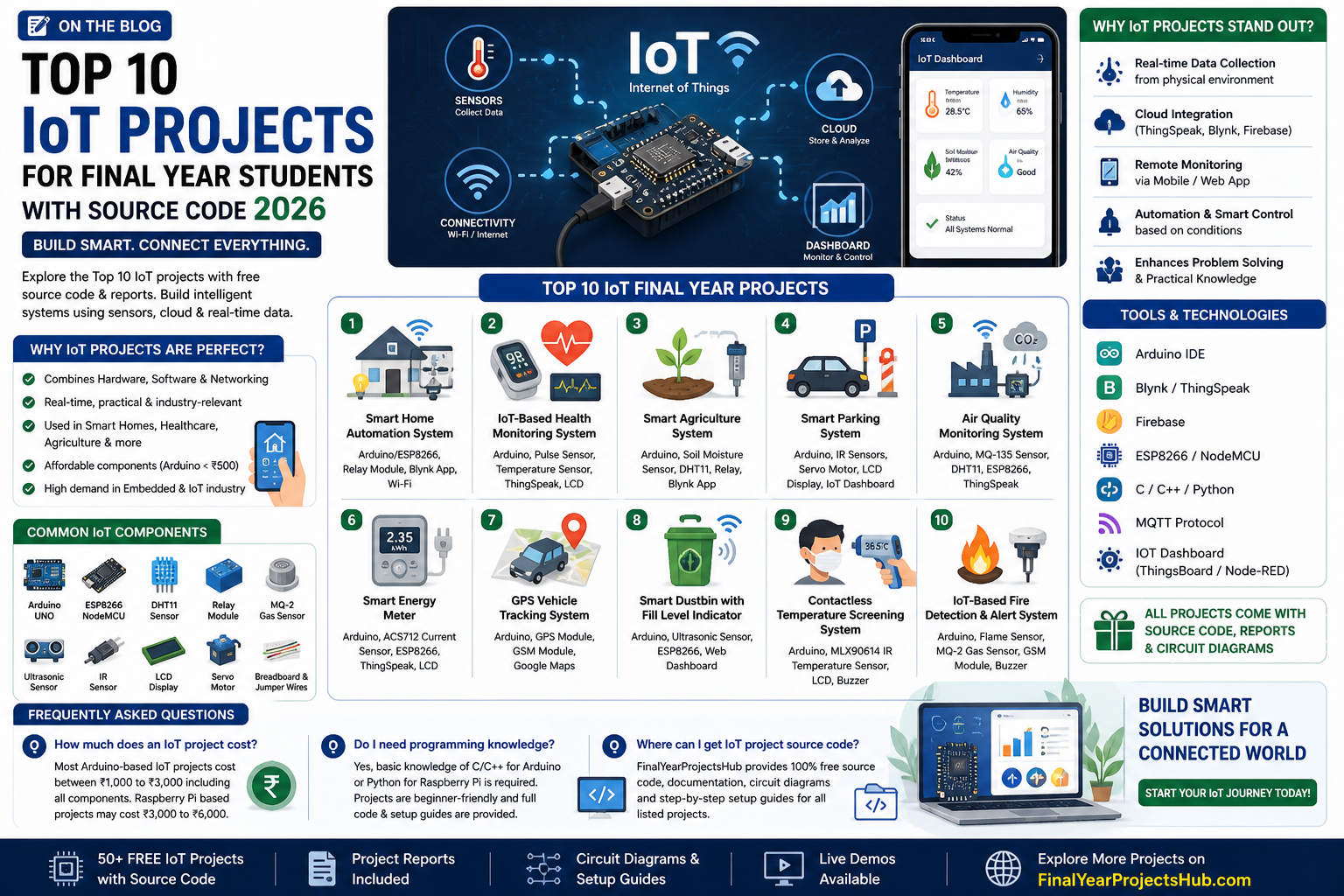
Top 10 IoT Projects for Final Year Students with Source Code 2026
Internet of Things (IoT) combines hardware and software to build intelligent connected systems. IoT projects are among the most visually impressive final year projects you can build — they involve real sensors, real data, and physical devices that interact with the world.
Why IoT Projects Are Perfect for Final Year
- Combines hardware, software, and networking — shows diverse skills
- Produces a physical, working system that is impressive during viva
- IoT is used across every industry: healthcare, agriculture, smart homes, industry
- Hardware components are affordable — Arduino Uno costs under ₹500
- Highly valued by embedded systems and IoT companies during placements
Top 10 IoT Final Year Projects
1. Smart Home Automation System
Technologies: Arduino/ESP8266, Relay Module, Blynk App, Wi-Fi
Control home appliances (lights, fans, AC) remotely via a smartphone app. Uses voice commands and scheduled automation for convenience and energy saving.
2. IoT-Based Health Monitoring System
Technologies: Arduino, Pulse Sensor, Temperature Sensor, ThingSpeak, LCD Display
Monitors patient heart rate, body temperature, and oxygen saturation in real time. Sends data to the cloud and triggers alerts when readings exceed safe thresholds.
3. Smart Agriculture System
Technologies: Arduino, Soil Moisture Sensor, DHT11, Relay, Blynk App
Monitors soil moisture, temperature, and humidity. Automatically activates irrigation when soil moisture is low. Sends real-time data to a mobile dashboard.
4. Smart Parking System
Technologies: Arduino, IR Sensors, Servo Motor, LCD Display, IoT Dashboard
Detects available parking slots using IR sensors and displays real-time availability on an LCD and a mobile app. Guides drivers to empty spots automatically.
5. Air Quality Monitoring System
Technologies: Arduino, MQ-135 Sensor, DHT11, ESP8266, ThingSpeak Dashboard
Measures air quality parameters including CO2, smoke, and particulate matter. Displays data on an IoT dashboard with historical charts and pollution alerts.
6. Smart Energy Meter
Technologies: Arduino, ACS712 Current Sensor, ESP8266, ThingSpeak, LCD
Monitors real-time electricity consumption and calculates monthly bill estimates. Sends alerts when consumption exceeds a set limit.
7. GPS Vehicle Tracking System
Technologies: Arduino, GPS Module, GSM Module, Google Maps
Tracks vehicle location in real time using GPS and displays it on Google Maps. Sends SMS alerts when the vehicle moves outside a defined geographic boundary.
8. Smart Dustbin with Fill Level Indicator
Technologies: Arduino, Ultrasonic Sensor, ESP8266, Web Dashboard
Monitors dustbin fill levels using ultrasonic sensors and notifies sanitation workers when bins are full. Reduces unnecessary collection trips and improves city waste management.
9. Contactless Temperature Screening System
Technologies: Arduino, MLX90614 IR Temperature Sensor, LCD, Buzzer
Measures body temperature without contact and triggers an alert if it exceeds 37.5°C. Practical, real-world project highly relevant post-pandemic.rch.
10. IoT-Based Fire Detection and Alert System
Technologies: Arduino, Flame Sensor, MQ-2 Gas Sensor, GSM Module, Buzzer
Detects fire and smoke in real time and sends immediate SMS alerts to emergency contacts while triggering a local buzzer alarm.
Frequently Asked Questions
1. How much does an IoT final year project cost?
Most IoT projects using Arduino cost between ₹1,000 and ₹3,000 for all components. Projects using Raspberry Pi may cost ₹3,000 to ₹6,000. This makes IoT projects very affordable for most students.
2. Do I need programming knowledge for IoT projects?
Yes, basic C++ knowledge is needed for Arduino projects and Python for Raspberry Pi. Most IoT project code is straightforward and well-documented. FinalYearProjectsHub provides full code and setup guides.


Leave a Reply