
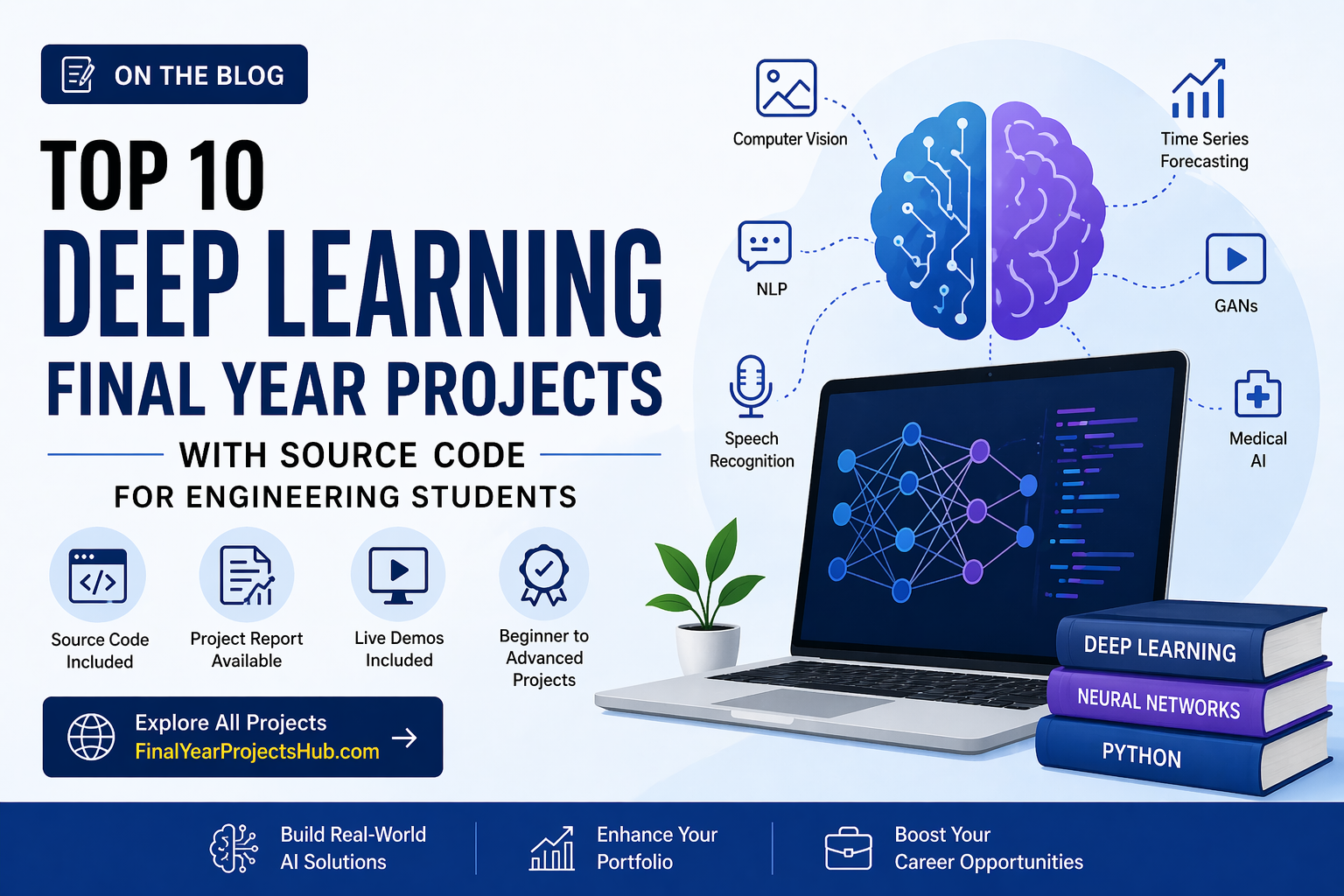
If you want a final year project that truly impresses — Deep Learning projects are the gold standard. They demonstrate advanced AI skills that are rare among graduates and highly sought-after by employers in 2026.
In this guide, we cover the Top 10 Deep Learning final year projects with free source code, project reports, and live demos — all available on FinalYearProjectsHub.
Why Deep Learning Projects Are Worth It
- Powers real-world tech: face unlock, YouTube recommendations, Tesla Autopilot
- Covers advanced topics: CNN, LSTM, RNN, Transfer Learning, GAN
- Commands top salaries in data science and AI roles
- Demonstrates you can handle complex, research-level problems
- Perfect for students targeting FAANG, product companies, or research roles
Top 10 Deep Learning Final Year Projects
1. Image Caption Generator
Automatically generates natural language captions for images by combining CNN (for vision) and LSTM (for language). Combines two major deep learning architectures in one impressive project.
- CNN feature extraction with VGG16/InceptionV3
- LSTM-based sequence generation
- Trained on Flickr8k or MSCOCO dataset
- Interactive image upload web interface
2. Music Genre Classification
Classifies music into genres (Rock, Pop, Jazz, Classical, etc.) by converting audio into Mel-spectrograms and feeding them to a CNN. A unique and impressive project combining audio + vision AI.
- Audio feature extraction with Librosa
- Mel-spectrogram image generation
- 90%+ accuracy on GTZAN dataset
3. Deepfake Detection System
Detects AI-manipulated deepfake videos and images using binary classification with a deep neural network. Highly relevant to AI ethics and cybersecurity discussions.
- Frame-by-frame video analysis
- Binary classification (real vs. fake)
- FaceForensics++ dataset training
4. Handwritten Text Recognition
Converts handwritten text from images into editable digital text using a CNN+LSTM hybrid model. Useful for digitizing handwritten documents and old records.
- CNN for visual feature extraction
- Bidirectional LSTM for sequence modeling
- CTC loss for sequence-to-sequence learning
5. Weather Forecasting with LSTM
Predicts temperature, humidity, and rainfall using historical weather data and LSTM networks. A practical time-series forecasting project with clear real-world value.
- Multi-step time series forecasting
- LSTM sequence modeling
- Interactive visualization dashboard
6. Fashion Item Classification
Classifies 10 types of fashion items (shirts, shoes, bags, dresses) using CNN on the Fashion-MNIST dataset. A clean, well-documented beginner deep learning project.
- CNN architecture design from scratch
- 99%+ accuracy on Fashion-MNIST
- Real-time image prediction interface
7. Cancer Cell Classification
Classifies cancer cells in microscopy images as benign or malignant using deep CNN. Combines medical AI with explainable AI using Grad-CAM visualization.
- Histopathology image classification
- Grad-CAM for model explainability
- BreakHis or PCam dataset training
8. Vehicle Number Plate Recognition
Automatically detects and reads vehicle number plates from images or live video. Used in toll systems, parking management, and traffic enforcement.
- License plate detection with OpenCV contours
- OCR using TesseractOCR engine
- Works on Indian and international plates
9. Drug Discovery with GNN
Predicts drug-molecule effectiveness using Graph Neural Networks (GNN) — a cutting-edge intersection of AI and pharmaceutical research.
- Molecular graph representation learning
- Drug-target interaction prediction
- ChEMBL or PubChem dataset training
10. AI Game Agent (Deep Reinforcement Learning)
Trains an AI agent to play games like CartPole or Pong using Deep Q-Network (DQN). The agent learns entirely through trial and error — no human examples needed.
- Deep Q-Network (DQN) implementation
- Reward shaping and replay buffer
- Real-time game visualization
Hardware & Software Requirements
Install All Required Libraries
pip install tensorflow keras numpy pandas matplotlib seaborn scikit-learn opencv-python flask pillow librosa
Frequently Asked Questions (FAQ)
1. Which deep learning project is best for final year students?
Image Caption Generator, Cancer Cell Classification, and Deepfake Detection are among the best because they cover multiple advanced concepts (CNN, LSTM, Transfer Learning) and have clear real-world value.
2. What is the difference between Machine Learning and Deep Learning projects?
ML projects use traditional algorithms (Random Forest, SVM). Deep Learning uses neural networks (CNN, LSTM, RNN) that automatically learn features from raw data like images, audio, and text — requiring less manual feature engineering.
3. Do I need a GPU for deep learning projects?
Not necessarily. Google Colab provides free GPU access. Projects using transfer learning (pre-trained models) can often run on a regular laptop CPU in reasonable time.
4. How long does a deep learning final year project take?
Beginner projects (Fashion Classification) take 1–2 weeks. Intermediate (Weather Forecasting, Number Plate Recognition) take 2–3 weeks. Advanced projects (Image Captioning, Drug Discovery) may take 4–6 weeks.
Leave a Reply