
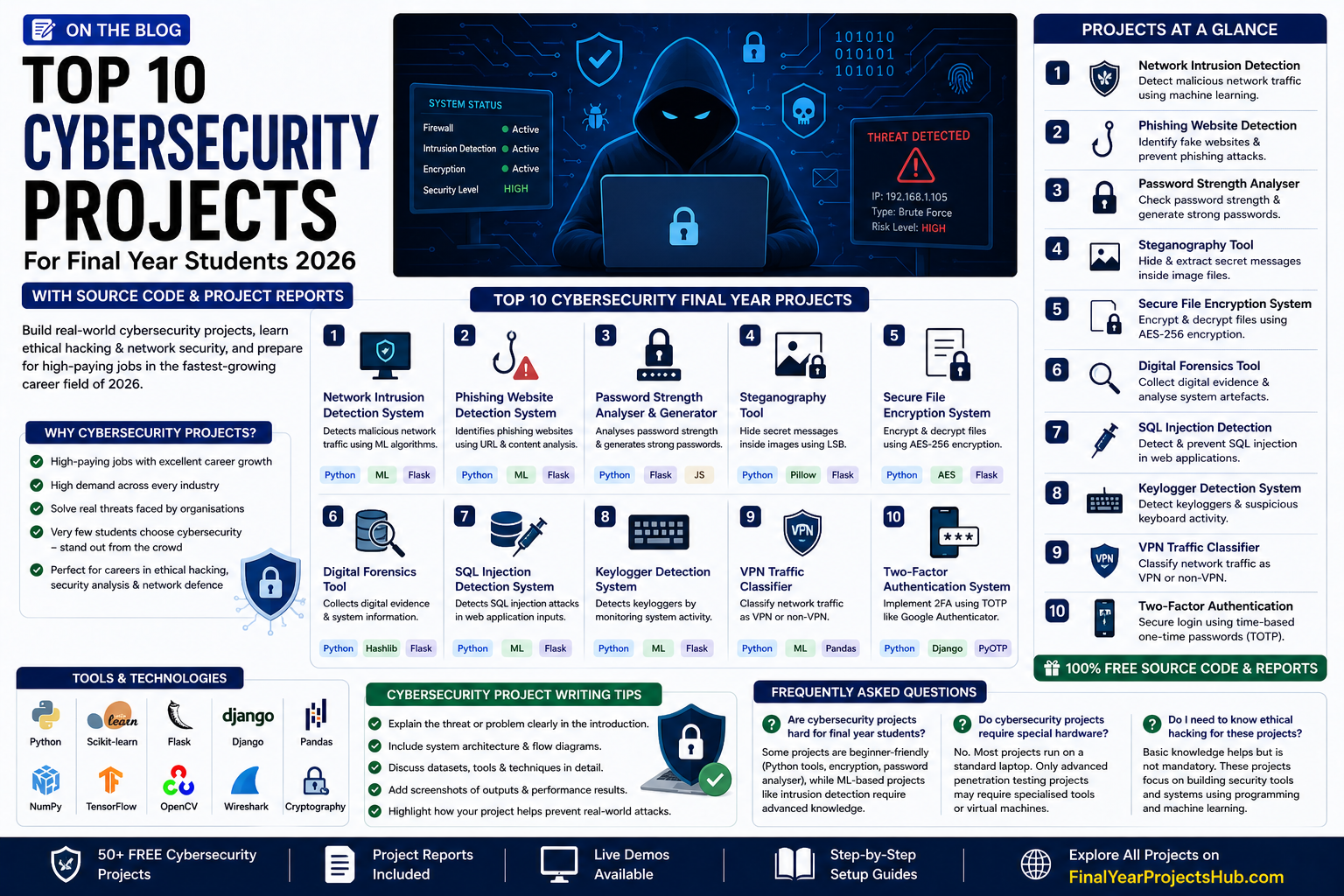
Top 10 Cybersecurity Projects for Final Year Students with Source Code 2026
Cybersecurity is one of the fastest-growing career fields in 2026. With data breaches, ransomware attacks, and online fraud increasing every year, organisations desperately need skilled cybersecurity professionals. A cybersecurity final year project positions you perfectly for this high-demand career path.
Why Cybersecurity Projects Stand Out
- Cybersecurity jobs are among the highest paying in IT with starting salaries well above average
- Very few students choose cybersecurity projects – making you immediately stand out
- Demonstrates understanding of real threats companies face every day
- Directly applicable to careers in ethical hacking, security analysis, and network defence
Top 10 Cybersecurity Final Year Projects
1. Network Intrusion Detection System
Technologies: Python, Scikit-learn, Pandas, KDD Cup Dataset, Flask
Detects malicious network traffic patterns using machine learning. Classifies network connections as normal or attack types including DoS, probing, and R2L attacks.
2. Phishing Website Detection System
Technologies: Python, Scikit-learn, Flask, URL Feature Extraction
Automatically identifies phishing websites by analysing URL characteristics, domain age, SSL certificate status, and content features using a machine learning classifier.
3. Password Strength Analyser and Generator
Technologies: Python, Flask, zxcvbn library, JavaScript
Analyses password strength in real time using pattern matching and entropy calculation. Generates strong, customisable passwords and explains why certain passwords are weak.
4. Steganography Tool
Technologies: Python, PIL/Pillow, Flask, LSB Algorithm
Hides secret messages inside image files using the Least Significant Bit (LSB) steganography algorithm. Also extracts hidden messages from images. A unique and impressive project.
5. Secure File Encryption and Decryption System
Technologies: Python, Cryptography library, AES Encryption, Flask
Encrypts and decrypts files using AES-256 encryption — the same standard used by banks and governments. Includes a password-based key derivation system.
6. Digital Forensics Tool
Technologies: Python, PyAutoGUI, Hashlib, Flask
Collects digital evidence from computer systems including file metadata, hash values, browser history, and recently accessed files. Used in forensic investigations.
7. SQL Injection Detection System
Technologies: Python, Scikit-learn, Flask, OWASP Dataset
Detects SQL injection attacks in web application inputs using pattern matching and machine learning. Provides a web interface for testing input strings.
8. Keylogger Detection System
Technologies: Python, Process monitoring, Flask, Machine Learning
Monitors system processes and keyboard activity patterns to detect keyloggers running on a system. Sends alerts when suspicious activity is detected.
9. VPN Traffic Classifier
Technologies: Python, Scikit-learn, Pandas, Network Traffic Data
Classifies network traffic as VPN or non-VPN using machine learning techniques applied to packet-level features. Useful for network security research.
10. Two-Factor Authentication System
Technologies: Python, Django, PyOTP, QR Code Generation
Implements a complete two-factor authentication (2FA) system using Time-based One-Time Passwords (TOTP) similar to Google Authenticator. Highly practical security project.
Frequently Asked Questions
1. Are cybersecurity projects hard for final year students?
Projects like Password Strength Analyser, File Encryption Tool, and Steganography Tool are accessible to students with intermediate Python skills. More advanced projects like Intrusion Detection require knowledge of machine learning.
2. Do cybersecurity projects require special hardware?
Most software-based cybersecurity projects run on a standard laptop. No special hardware is required for projects like phishing detection, encryption tools, or password analysers.



Leave a Reply