
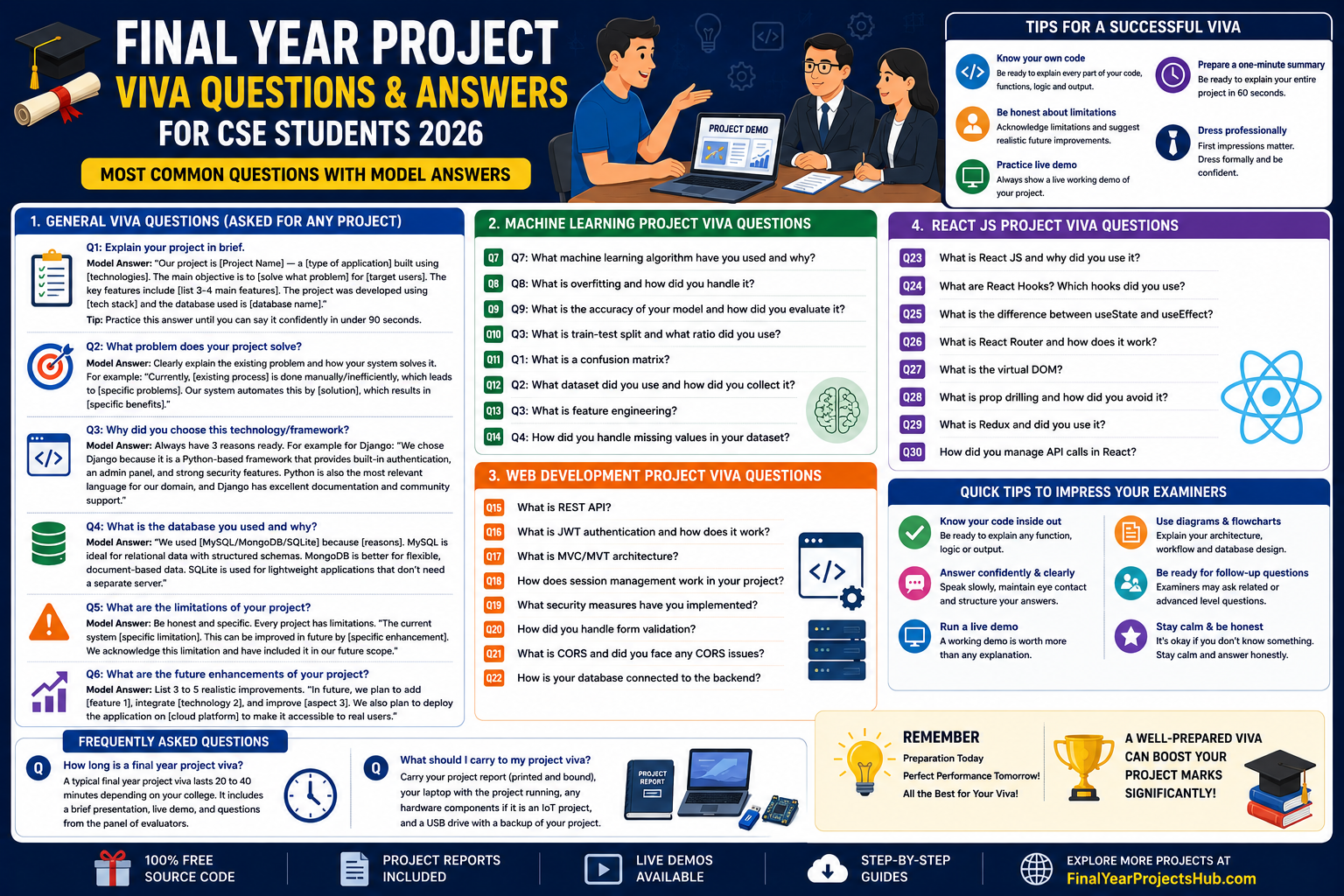
Final Year Project Viva Questions and Answers for CSE Students 2026
The final year project viva is one of the most important — and most nerve-wracking — parts of your engineering or MCA journey. A well-prepared viva can significantly boost your marks, while a poor performance can bring down an otherwise excellent project.
This guide covers the most common final year project viva questions with model answers across all major project categories.
General Viva Questions
1. Explain your project in brief.
Our project is [Project Name] — a [type of application] built using [technologies]. The main objective is to [solve what problem] for [target users]. The key features include [list 3-4 main features]. The project was developed using [tech stack] and the database used is [database name].
Tip: Practice this answer until you can say it confidently in under 90 seconds.
2. What problem does your project solve?
Clearly explain the existing problem and how your system solves it. For example: “Currently, [existing process] is done manually/inefficiently, which leads to [specific problems]. Our system automates this by [solution], which results in [specific benefits].”
3. Why did you choose this technology/framework?
Always have 3 reasons ready. For example for Django: “We chose Django because it is a Python-based framework that provides built-in authentication, an admin panel, and strong security features. Python is also the most relevant language for our domain, and Django has excellent documentation and community support.
4. What is the database you used and why?
We used [MySQL/MongoDB/SQLite] because [reasons]. MySQL is ideal for relational data with structured schemas. MongoDB is better for flexible, document-based data. SQLite is used for lightweight applications that don’t need a separate server.
5. What are the limitations of your project?
Be honest and specific. Every project has limitations. “The current system [specific limitation]. This can be improved in future by [specific enhancement]. We acknowledge this limitation and have included it in our future scope.”
6. What are the future enhancements of your project?
List 3 to 5 realistic improvements. “In future, we plan to add [feature 1], integrate [technology 2], and improve [aspect 3]. We also plan to deploy the application on [cloud platform] to make it accessible to real users.”
Machine Learning Project Viva Questions
7. What machine learning algorithm have you used and why?
8. What is overfitting and how did you handle it?
9. What is the accuracy of your model, and how did you evaluate it?
10. What is a train-test split, and what ratio did you use?
11. What is a confusion matrix?
12. What dataset did you use and how did you collect it?
13. What is feature engineering?
14. How did you handle missing values in your dataset?
Web Development Project Viva Questions
15. What is REST API?
16. What is JWT authentication and how does it work?
17. What is MVC/MVT architecture?
18. How does session management work in your project?
19. What security measures have you implemented?
20. How did you handle form validation?
21. What is CORS and did you face any CORS issues?
22. How is your database connected to the backend?
React JS Project Viva Questions
23. What is ReactJS and why did you use it?
24. What are React Hooks? Which hooks did you use?
25. What is the difference between useState and useEffect?
26. What is React Router and how does it work?
27. What is the virtual DOM?
28. What is prop drilling and how did you avoid it?
29. What is Redux and did you use it?
30. How did you manage API calls in React?
Tips for a Successful Viva
Know your own code: Never include code in your project that you cannot explain. Evaluators will ask about specific functions and you must be able to explain them.
Be honest about limitations: Pretending your project is perfect will backfire. Evaluators respect students who acknowledge limitations and suggest future improvements.
Practice live demo: Always run a live demo during your viva. A working demonstration is worth more than any explanation.
Prepare a one-minute summary: Be ready to explain your entire project in 60 seconds. This is often the first thing you are asked.
Dress professionally: First impressions matter. Dress formally for your viva presentation.
Frequently Asked Questions
1. How long is a final year project viva?
A typical final year project viva lasts 20 to 40 minutes depending on your college. It includes a brief presentation, live demo, and questions from the panel of evaluators.
2. What should I carry to my project viva?
Carry your project report (printed and bound), your laptop with the project running, any hardware components if it is an IoT project, and a USB drive with a backup of your project.


Leave a Reply